Pages

Saturday, 24 December 2011

Merry Christmas

It's that time of year.

I've not written since getting home and it's weird how quickly I miss it. So here I am again.

Today our church here had the Christmas Eve service. There was a...well...a moment. I can't describe it. But as everyone in the church lit their candles creating a growing glow as we sang "Light of the World" (well, not "we") I suddenly got the shivers. It was...just that. A moment. I simply cannot describe it with words.

Anyways, it is late. And if I don't hurry I'll be going to bed on Christmas morning...and we can't have that, can we?


Monday, 19 December 2011

Physics physics physics

Today I have a physics final. So you get a special treat; my rantings on physics! Basically I'm going to write about as much as I can without looking up formulas and whatnot. So let's go.


First, Newton's three laws.

  1. An object in motion stays in motion unless acted upon by some outside force. Likewise, an object at rest stays at rest unless acted upon by some outside force. Simple enough to understand.

  2. F = ma. Force equals mass times acceleration. If I apply a constant force of ten newtons to a small item weighing five newtons then it accelerates at two meters per second squared. (basically two meters per second per second). Also not complicated at all.

  3. For any action there is an equal and opposite reaction. Not quite so intuitive as the others. But trust me the forces do always balance. Force (One on Two) = -Force (Two on One)


Okay moving on, now that those are established. Any object resting on a surface has two forces acting on it. But, isn't it at rest? (Look at law 1). Yes. There is a downwards force of gravity which is mass times acceleration due to gravity and a contact force with the surface which, surprise surprise, is equal and opposite to the force of gravity. So the sum of the forces is zero. Now, friction. The force of friction always opposes motion, no matter which way it goes. The force is equal to (mu)n. What the heck is this? (mu) is a greek letter. It represents the coefficient of friction, static or kinetic (it's not hard to figure out what those mean...they are indeed as obvious as they seem). This value will vary between surfaces. The smaller it is the smaller the force of friction (obviously). The other bit, n, is the normal force. This is that contact force I was blabbing about a moment ago. So F = (mu)n for friction. Good. Quick quick quick time's running out. Lot more to cover here. Circular motion. An object in circular motion, even uniform circular motion (it means what you think it means), is always accelerating. Even if the speed never changes. Why? Because acceleration is defined as dv/dt, or change in velocity over time, for those of you who don't know calculus....yet (and why don't you, anyways?). Velocity is not just speed, as much of the world thinks. Velocity includes direction. Twenty km/h is a speed. Twenty km/h north is a velocity. So if your direction changes you are said to accelerate, even if you never speed up or slow down. So moving in a circle means there is a constant acceleration pointing straight at the centre of the circle. Think of the last time you spun something on a string. There you go. The string is like the vector of acceleration, called radial or centripetal acceleration. This is equal to velocity squared over the radius. And then if it's not uniform circular motion you have tangential acceleration which, again, is exactly what it sounds like. Acceleration perpendicular to the radius. On to energy. There are two forms of energy covered in this course; kinetic and potential. Kinetic, given by ½ mv^2, is for an object in motion. Potential, mgh, is the amount of kinetic energy the object could potentially have. Hold a book 2 meters above the floor (if you can reach). Assume the book weighs about 5 kilos the potential energy is 5 kg x 9.81 m/s^2 x 2 m. This is equal to 98.1 Joules. If you drop it, it will quickly accelerate downwards. Energy is conserved in the absence of non-conservative forces so the kinetic energy of the book an instant before hitting the ground with a bang and subsequently getting your mother to ask what the heck you think you're doing will be equal to 98.1 Joules. Because we all know algebra it's not hard to see that ½ mv^2 = mgh, so cancel the ms, multiply by two and take the root of both sides and you see that v = sqrt(2gh) which is sqrt(40). So that's how fast the book was falling just before hitting the ground.

Sadly time is already up. I didn't get to go into momentum, collisions, rotational dynamics, rocket propulsion, Kepler's laws, waves, sound, or any of that good stuff. But anyways. Hopefully you feel a little smarter.

And never forget the difference between speed and velocity.

Thursday, 15 December 2011

Metro Minute: Solar Powered

Something I've discovered of late is how much we, or rather, I and thus extrapolated with somewhat erroneous logic to the rest of the world, need the sun. Not because of the obvious reasons; to see, to grow our food, and so on. I personally find that I need some kind of connection with it during the day or else I feel absolutely disgusting. It doesn't even need to be sunny outside; so long as I see some natural light.

Why does this come up? Well, for anyone living in the northern hemisphere it's started getting dark very early. A little earlier for me than most readers as I'm further north but not a huge difference. That's not even important here so I don't know why I mentioned it, or indeed why I'm even saying that I don't know why I mentioned it. Moving on. Recently for me with finals I've been spending a lot, and I mean a lot, of time in the library. More than I would have expected myself to spend. The thing is, as it's dark by 16h or so, work is done entirely by artificial lighting for most of the day. And this is painful.

Whenever I go to study I try to get a desk by the window so I can at least have some kind of link with what's happening outside. One thing that really bothered me was working in the labs for chemistry and physics, although physics was the worse of the two; both labs were in the basement, the chem lab having a few small windows for air circulation but those hardly let light in. The physics lab was completely windowless and deep underground. Why was this a problem? Well, I would go into the lab for 14:30 and emerge three hours later. It would have been nice and sunny when I went in but coming out it's pitch black. All the while my body was in a bright environment. While I didn't necessarily feel physically ill as we know that word to mean I had this general feeling of unwellness growing during the lab. Same goes for the library and this is why I try to get a desk by the window. Having that view outside with the ability to the natural light lele helps me keep a good grasp on what is actually going on in the world of orbital motion.

I'm just going to theorize here so feel free to completely disagree. And tell me so. My comment heading commands you. This is my theory (as unofficially stated as it is). We, as humans, all have an internal clock of some sort, agreed? It wakes us up in the morning (unless we have an alarm clock), it allows us to have a general idea of the progress of the day, and it tells us what to expect for natural light. This last part is the important bit. I may have phrased it wrongly but I'll discuss it and we'll see.

When you're in an environment where you are going inside and outside or at least from windowless to windowed rooms, you can keep track of time relatively easily by looking outside. This act “resets” your internal clock to keep it accurate. As you go back into an area wit h no connection to the great outdoors your clock will keep general track of time, but it loses itself very quickly. We have all read at some point in our lives stories of wretched prisoners cast into dark dungeons for so long that they cannot track the passage of time. Our internal clock has a pretty high entropy. It winds down quickly. So while yes, it is predicting the light levels outside, it's often wrong if you've been inside for an extended period of time.

Back to the lab example. I leave the outdoors, a bright environment, and go into an underground, bight environment. I start my work, get absorbed in it, and stop paying great attention to time. When my mind did not have this work to occupy itself with, it suddenly perks up and says, “Good grief how long have we been here? The light hasn't changed at all! Has time even passed?” When I step outside and see how much time has indeed passed things are revealed to be screwy and feel unwell. Even though I may know three hours have passed it's not until I see it that the full impact hits.

Anyways, there's my theory. I'm out of time for this. Back to studying...


Tuesday, 13 December 2011

Metro Minute: Winds of Change

Change. Yes, change. That thing everyone is scared of and yet demands. That thing that is never noticed when it's happening but seems dramatic and obvious in retrospect. That thing homeless people ask for. Okay maybe not that last one. I'm talking about change as in lifestyle. Heck , just life.

Coming to university I was nervous. I was scared. A little. For starters I was going to be living in a city that is about eighty times the size of my home country. Chew on that for a moment. Then, of course, I was moving from being homeschooled to attending a high end university. Also, I'm leaving my family behind and now living with my grandmother and cousin. Hardly the full house I'm used to. In addition, everyone was telling me to savor my last few weeks at home because when I came back for the holidays it would never be the same as before. This all had me worried. My life was about to change. A lot.

But then it didn't. Or at least, I didn't think it did. My family stayed in Montreal for about a week into my semester. Initially I found that annoying and irritating but in retrospect it was a very helpful way to transfer over into university. As the student services happened to be striking for most of the semester there were a few unexpected kinks and wrinkles that needed sorting out and it was helpful to have my parents a phone call away or closer at all times during the first week. They then left and I figured that the expected “culture shock” that I had been anticipating with excitement and dread for a while was about to happen.

For starters, it's kinda weird to “expect” a shock of sorts. I mean, the whole thing with a shock is that it's unexpected, right? Well, for me it just didn't happen. Montreal is my birthplace and home away from home already. It's a familiar place. Granted I was seeing a whole other side of it being in university and all but it was still familiar. Homely. Comfortable. A few weeks passed and I was finding my rhythm with school, church, and becoming more and more familiar with everything. Suddenly I realized that I hadn't had any transition really. I never felt like I was in a strange environment. I had to remind myself at times, “Nathaniel...you're in university now. The next step in life! You're gone from home! This is big! You should be kinda shocked right now.” But no. I kept gliding through as if nothing had changed.

Another thing was my connection back home. Thanks to the magic that is technology I have been still able to maintain a near constant link back home. At times this is annoying and I'd like to be left alone but at least it's easier to ignore a blinking phone than it is an actually person speaking in front of me. However, it's still helpful to maintain a lot of the comfort of “home”. This all said I was warned that “home” would never be the same. It would never look the same again. It would still be nice to return there but it would, from then on, be merely a temporary stay. I no longer “live” there. I'm welcome to long visits but am no longer a proper resident. But, as somewhat worrisome as this may be I've again not really noticed any real, tangible change.

Finally, there are my siblings. Due to the constant connection I had with them in living under the same roof as them I knew I'd be happy to get away and believe me I certainly was. Again, ignoring skype is much, much easier than a persistent little sister (even though she's still persistent on skype...”away” means “away”. It does not mean “call me I'm dying to hear from you”). However, with the older two, Jordan and Abigail, the relationship between us has changed. Again, not in any really noticeable form over time but looking back holy cow is it ever different. Not having to interact with each other every single day means our communications are purely voluntary and we both want to be in conversation together. If you want to do something, you're automatically going to enjoy it more. It's an amazing thing. I've always wondered how it will work as we all grow up and spread out across the planet. My aunts and uncles on my father's side all, with the exception of one, reside in Bermuda, meaning they're all very close. Will it be the same with me and my own siblings? I now have seen a small glimpse into what it will be like.

Life is completely different now. I didn't want things to be different. I liked my life at home. I was able to subsist on a wonderful diet of math, music, computers, and photography. I loved it. It was comfortable. Familiar. Life was good. But now it has all changed. Again, I didn't want it to change, but oh my. Is it ever wonderful here on the other side. The weirdest thing is though; I knew it would change, I expected it to change, I have seen that it has changed, but, I never saw it change. I did not notice a thing. My piano teacher drew a good analogy; it's like getting taller. Suddenly you realize you can see the top of a table. That's a big milestone. But you probably didn't notice the progress being made to that point. So now here I am, seeing the top of the table for the first time. I'm noticing the drastic difference from before when I couldn't see it. But I didn't notice a thing meanwhile. And that, I think, is a great way to change.

Thursday, 8 December 2011

Metro Minute: Now You're Thinking with Pressure

I'm riding the metro into school for my last day of review before my first exam. This exam carries 75% of my grade for the course. Not exactly a small amount. The pressure is certainly mounting. Which is what I'm going to yak about for the next twenty minutes or so.

What is pressure? Not the physical pressure, no, that I understand just fine. But what is it that makes field goal kickers crack, performers slip, and stress on students? Again, not physical pressure, although that could explain each of those things but the emotional pressure. Mental pressure.

If we're honest with ourselves we all know we want others to at least respect us (however little our behavior indicates that...yes, Rose...). We like being able to do things and do those things well. It is part of the reason we don't immediately volunteer what information we have about a subject because we don't think said information is effective enough or complete. Ask an open question in a classroom of students and, while hopefully at least most of them know the answer hardly anyone will say anything. Partly because they're not comfortable speaking for everyone to hear but also because there's that little voice in one's mind saying, “What if you're wrong? What then?”

So this comes back to pressure. It is appropriately named because it really is a result of people heaping expectations upon you. Those all weigh down on your mind. You know that these people will think of well of you if you meet those expectations and won't if you don't. This is why I rambled a bit a moment ago. Whenever a certain level of performance or quality of work is expected there is pressure to meet that level. Particularly if that level is just about the highest you personally can possibly reach.

Take, for example, frisbee. I love to play and I'm not trying to brag when I say I'm a pretty good player. When I left Bermuda for university a lot of people were disappointed to see me go as I would no longer be there for the weekly games. Now that I'm going back for Christmas all those people are eagerly awaiting my return and will obviously expect me to play at the same high level I did all of last year (academic year, that is). However, I haven't actually thrown a frisbee for almost two months. That's a long time to go without throwing a frisbee. There's bound to be some level of rust and I'm not going to meet those expectations right away. Add to this that I know that and they don't and there's a lot of pressure build up. Which makes the whole situation worse.

But anyways. All that to say I'm under a lot of pressure for these finals. A lot of people expect a lot. The good news is that I know I'm capable of meeting those expectations. The bad news is I'm not sure if I will....hence, pressure.

Tuesday, 6 December 2011

Metro Minute: Where I'm Supposed to Be

I know, it's been a while since I've written anything here. However, my travel schedule has been completely changed recently as I am now entering the university equivalent of the Twilight Zone. The lines between studying and sleep will become increasingly blurred and I'll wake up suddenly as if out of a dream on the 21st and realize I'm on an airplane home. This all said,I really have nothing planned to write here but just really wanted to write. I don't know why as I don't know what.

One thing that's become increasingly clear is that I am definitely in the right place. Often when students go off to university the last thing you expect them to do is to instantly grow in their walk with Christ. They don't necessarily need to get worse, no, but to grow? Seems a bit odd for their first year (unless of course they are in a Christian university, but even then). And yet, that's exactly what has happened here.

From day one my parents made absolutely sure I was placed in a church with people my age that I could identify with. This has been extremely useful. Normally when we come here we go to my grandmother's church which is a quiet, sleepy sort of place with an average age well over sixty. I certainly did not relish the thought of going there. However, my parents have roots here in a church closer to downtown which, while not void of elderly (and honestly a church would feel very weird without them; but this isn't the point look at the next phrase), has a vibrant and diverse youth group. On an average night there will be forty young people. Being around all these young Christians all going through the same things I am (school, finals, the transition from childhood to adulthood, etc.) has been invaluable. While I haven't gotten extremely “close” with anyone of the group yet I've still been inspired and encouraged by them in a major way.

But that is not all. I also, at the recommendation of my youth leader back home, got involved with Campus for Christ (which will soon be renamed Power to Change). This has been huge. A university campus is a big place. There are a lot of people; over 20,000 undergraduate students attend McGill. For someone like me who isn't exactly a social butterfly (understatement of the year I know) it can become a little overwhelming; all these people and you don't know a single one of them. As much as I hate to admit it I am still human and humans do need some level of acceptance by others. Well, “need” but that's a whole other topic. We all would get lonely without others by varying degrees. The point is, having a Christian circle of friends that you meet with once a week and often bump into on campus because of similar walking directions and paths has also been quite encouraging.

In addition, you will recall (okay maybe you won't, I don't know) that a few posts back I was talking about how I had, in the space of just three months, done something I had said I wouldn't do; that is, go “sharing” in the cafe. I have now done that twice and have lead one of the discussions as opposed to being “wingman”. If you told me back in September that I would have done that by now I, quite honestly, would have laughed in your face (I do that a lot regardless but that's still not the point). Also, I now eagerly look forward to my next opportunity to play the piano for worship at church, whereas a few months ago I was reluctantly taking my brother's place on the keys as he was needed elsewhere on the island for three weeks.

I still have a long way to go, however. I still struggle with various things. I still have unanswered questions. Heck, I'm still not completely certain I'm doing the right thing academically speaking. But I know that I'm getting closer and that I'm supposed to be here in McGill. That's a good starting point, don't you think?

Thursday, 1 December 2011

Human Error

Here's something I've often pondered: why are things hard to do? I mean really. Why do we as musician miss notes even after hours and hours of practice? How are mathematical concepts hard to learn? Why does it take such talent and training to play a sport professionally? Why is it so difficult to come up with a decent thought to write about?

And these aren't just rhetorical questions, either. Over the next twenty minutes (and probably some more while drinking coffee in the classroom half an hour before class) I'm going to try to work out some “answers” but that opening interrogative paragraph is honestly just as much to spark “discussion” (as much discussion one can have with three readers) as it is to set up the rest of this entry.

Let's take the first example to start. A lot of us have taken music at one point or another in our lives (speaking outside of said three readers here). We all know how it goes. You practice and practice and practice and then you go up on stage and miss notes left and right. How? If you already know what notes to play, then where does this disconnect come in between your brain and your hands? In fact, it's often almost assumed that a musician can learn the notes to a piece quickly enough and all that's left is the interpretation of those notes (which is a whole lot let me tell you). Basically, a purely mechanical function shouldn't be difficult to someone properly trained.

Obviously with a beginner you would not start them with one of Rachmaninoff's piano concertos, pieces which are often considered the hardest piano pieces in the world (I've seen the music and I agree). Not because the difficulty merely comes down to a mental disconnect but because they have not learned the technique. With the technical side of piano playing there are certain manoeuvres that are not immediately obvious or intuitive and yet do work well. Case in point: my piano teacher showed me two days ago that crossing over the top of my hand in a given scenario was actually the best way to go about playing it. Did those notes instantly sound better? Yes. Was what I was doing before wrong? No. This goes back to there being no “wrong” in music (except for wrong notes but that's not the point....wait...yes it is).

Going back to the original topic, however, in my little rambly bit just now I was in fact trying to make a coherent point but wound up only confusing the matter further. If we say that it comes down to a lack of knowledge for the most part (which was the point I was trying to make) then how do we miss notes even when we do have great knowledge of the piece? Obviously this is not as much the case as when we first look at a piece but the point still stands.

What about math, now? Math is basically logic in its purest form. We've also all been there too; suddenly you realize you had no idea what was going on as of two weeks ago. Again, why? Why is it that a simple form of logic can be elusive to our minds? First there is the obvious point that math builds on itself. If I tried to teach you logarithmic differentiation without first teaching differentiation on its own we would be wasting our time. But differentiation just uses algebraic concepts. Therefore if one has already had the building block of algebra placed, differentiation should be easy enough to master. And yet at the same time, I doubt I could manage to get my brother to absorb that information and know how to use it.

Well, that's all the time I have here. I may continue this. I may.

Wednesday, 30 November 2011

Metro Minute: Study Habits

I know, I know, I've missed two days on this. But as I said very clearly yesterday, there are finals.

Today has been an unusual day in that I didn't actually take the train in this morning. Ergo, no trains of thought. But now that I'm on the metro I have a few thoughts floating about in my head. Most of them involve linear algebra and physics but those are not the subjects I'm here to talk about. Well, not directly, at least.

Studying. We all do it or have done it. It's one of those things that, well, at least I personally, find tricky to properly quantify. How much is enough? At what point does my studying stop being an efficient use of my time? What is the proper balance of sleep time, study time, and break time? Granted, some of these things can be determined as we go but it would be very nice to have some kind of concrete idea before hand; it would make planning out the day so much simpler. Last night, for example, I intended to stay in the library until almost nine, at which point I would take the last train home, get there at about ten-thirty and get to bed relatively quickly. However, after the amount of work I had done up to that point by about seven I was completely sick and tired of doing anything that required more brain function than pushing shiny buttons and went home (setting a record for time elapsed while doing so; got home in about seventy minutes). This morning my plan was to get to school for nine and spend three hours or so in the library before heading to class, but evidently that plan has changed.

Also, I've wound up being the head honcho of a study group; not that I'm the brightest but in that I'm the only one who will take the time to coordinate it. With that comes the expectation that I've planned out in some respect how to spend the time or what the group will study. But how does one do this? Study sessions in omnibus were a piece of cake; before the session spend at least an hour looking at the guide and filling in what you know (and doing at least some research on the rest), then go in, give what you know and chances are the other people knew other things better leading to a well-rounded exchange of information. At least in theory. But here we don't have those. Use past finals? Great. Only everyone uses those up so fast there's no point within about two days of them being uploaded. So now I'm trying to think of an idea or two to be able to get some kind of decent study session together for linear algebra, but due to a) the suckiness of the textbook (biggest waste of a hundred bucks ever) and b) the small number of past finals available I really haven't much to work with. I certainly can't “teach” the material in a review sense as I'm largely the one in need of review. Which leaves me with very few options, none of which I can see at the moment.

Friday, 25 November 2011

The Desire for Love

Well. This is a weird topic for me, of all people. But Campus for Christ just hosted a discussion on the topic and why we (collectively as humans) need it. In my opinion the discussion wasn't brilliantly done in that the questions asked by the leader of the talk often revolved around the romantic side of love without explicitly stating as such. My group pretty consensually agreed that there were many different facets to it and what may be true in one case may not be in another.
As a side note, yes, the invitation to attend this discussion was opened campus-wide. It was not a purely Christian group. Which was a good thing.
The way the discussion was structured was that we would look at various forms of art and how they all speak of this idea of love, namely the internet, music, films, and literature. As I said already, these all were about the romantic form with the exception of literature (for which we looked at 1 Cor. 13; try discussing love in light of that with an atheist. It's not easy I can tell you that much).
Interestingly enough last week I attended the SOLA conference here in Montreal. Because I don't feel like describing it, google it. The point is that the speaker at said conference pointed out that in almost any country or rock song you'll find the singer complaining because they are so lonely or some ridiculous thing until they found “you” or “him/her”. This would indicate a nearly universal theme; that is, a desire for love. When we looked at music last night, the selected song was “Easier than Love” by Switchfoot. Basically, in the song the argument is made that we as a culture have a pretty horribly twisted and warped view of what love is. Having agreed back in the sixties that we all need to “feel the love”, the world today is now trying to figure out what “feel(ing) the love” really means. And judging from all the “sad” stories, the advice books, and such, I would hazard a guess we still don't really know what it means and that it is a pretty hard thing to do. In the song, Switchfoot makes the argument that we, as a culture, have made a backwards connection between sex and love. (Honestly this is getting weirder and weirder to write. But being my normal self at the discussion I made a grand total of one comment and do have things to say.) Now, as Christians we would believe that sex was created as a display of love between husband and wife, whereas now the culture as more or less reversed this and cheapened it to the point where it is supposedly equivalent to having love in your life. Plus, as Switchfoot claim, it's a lot easier than really loving someone. But why is that?
The reason is that we are pretty darn selfish people. 1 Cor. 13 explicitly states that love is not selfish. That's problem number one for us. To love someone you have to make sacrifices and give of yourself without expecting anything back. That, while being closely linked with my first statement, is still a major issue for us. It also takes commitment, something that a lot of people are scared of. Our culture's view is moving towards being “free”, something that is contradictory with the “tied down” nature of committing to really love someone.
I could probably go on about various aspects but I just wanted to get that out of my head so I don't have to think about it anymore. And no this isn't a sign of a change of view. I know, Chris...you were hopeful.

Thursday, 24 November 2011

Just Do It

Yesterday, around mid-afternoon, I went “sharing” with a second year student. This basically is going to people in the cafe and asking if they'd be open to having an honest discussion about spiritual matters. When I first heard about this it struck me as a little odd and knowing the heavily secular mindset of the world at large today I would have guessed that those who go sharing meet with a lot of rejections before finding someone willing to talk.

Much to my surprise, however, Marvin (the other student) and I had two good conversations that lasted almost half an hour each. Well, actually Marvin mostly had the conversations while I listened to everything going on (but yes I did say something in each, don't worry). To be honest, this was a little surprising for me; I was expecting a more rapid-fire session, going an average of five to ten minute per person in the cafe.

The discussions themselves were interesting. We had a short questionnaire to keep conversation and discussion going and generally we just worked through the list of questions. The first person we approached had a very interesting view on the world; he had been raised in, from what I could tell, a pretty traditionalist Christian family which gave him no real experience with what Christianity is truly about. He had a hard time with some of the principles of grace and salvation by faith alone. When we tried to explain that the works are not necessary for salvation he argued back that to him, people were more important that God and that we should prioritize treating others kindly (cue sarcastic comments here). Obviously Marvin and I explained as best we could how faith produces works and faith without works is dead (even though works are not needed for salvation). Ultimately I think he understood but could not believe that faith was so powerful as to change the naturally sinful and selfish nature of mankind.

The next person didn't have the strongest English in the world, meaning the conversation was a good deal slower and more basic as we both had a hard time understanding what the other was saying. With this person, however, we managed to get into the whole free will issue as stated that one of the questions he had regarded why some people are healthy, wealthy, and wise (not generally true but it's a quote bear with me) and some are the complete opposite. To explain that we tried giving a brief to complete explanation about how sin came into the world and ran into a hang-up on the concept of free will. That was certainly a new thing; I've debated free will/predestination plenty in omnibus class with fellow Christians who understand core doctrines (at least, I hope they do) and expressing oneself in that situation can be complicated enough already. Just imagine trying it with someone who doesn't speak much English nor has any Christian background at all (not even culturally).

However, the most surprising event of the hour was when we finished both conversations. We went upstairs, closed in prayer, and then Marvin reminded me about how back at the beginning of the year when he shared his story of starting to go sharing in the cafe another guy and I both said it wasn't likely either of us would be able to do that. And yet there I was, not even three months later, maybe even less than two, out doing what I said I'd probably never be able to do. I'm not sure if this next fact should worry me, but I had absolutely no recollection whatsoever of having said that, and it was only after a few more memory triggers that I managed to recover a vague recollection.

But anyways, there you go. I'm not going to really provide any intended “message” or “moral” from this little story. I'll leave that up to you.

And yes, there is a cookie in guessing where I got this last paragraph from.

Wednesday, 23 November 2011

...

This morning I actually had an idea about what to write, but just now as I pulled my laptop out I suddenly realized I had no idea of what I was going to write. Se let me do a little bit of recent events.

“Recent” being early this morning. It's snowing. And in pretty large quantities. The snow is falling thickly and heavily, wind is blowing it around, etc. This morning I brushed off my grandmother's car; I was practically shoveling it off the front of the car. And by the end of it I already was pretty well covered with snow. There is more snow than the forecast called for that's for sure.

Most, if not all, of my readers know about the snowstorm Connecticut got back in October. Granted, this isn't the same volume of snow but If I may brag about my city Montreal knows how to handle snow. Had we gotten the thirty centimetres or however much they ended up with we probably could have handled it. Why? Because we've (I use the term “we” here loosely) have had worse, and wound up in a similar situation. I am, of course, talking about the Ice Storm of 1998. There was so much snow, wind, and cold that the power lines across the province got covered in snow and ice, providing far more weight than they were ever designed to carry, and not only resulted in breakages but even some of the towers collapsed with all the snow and ice. The entire province, so far as I remember, was crippled.

ince then Montreal has gotten much, much better. They are one of the best cities when it comes to dealing with a large snowfall. Up until last night we had gotten about twenty minutes of light snowfall all year (speaking from a scholastic point of view). The kind of snow you see falling but melts before hitting the ground. Despite that, this morning, at 6:45 all the major roads in our area had already been ploughed, salted, and cleared. This is not even five hours after the snow started falling. If Montreal ever gets shut down because of a snowstorm you know it's bad.

What's my point in saying all this? Originally there was none other than to say it, but now I've realized there's a moral here. Mistakes and bad things happen. (Obviously!). But those events are a complete waste for everyone involved if they don't take what happened, analyzed what happened, and figure out how to use this information to prevent it from happening again and looking for clues to predict similar happenings and taking steps to prevent those. This is basically the engineering profession.

Well this concludes a rambling, off-topic and random section. I have no idea what or why I just wrote what I wrote. Hopefully I can get my thoughts together for tomorrow.


Also I regret wearing my running shoes....


Tuesday, 22 November 2011

...now what?

Well. I would be lying to say I didn't expect this. However, I didn't expect it so soon. But, somehow, I've lost my inspiration for writing. I come to write a new entry and suddenly my mind is blank. It's "Night Before Due Date" all over again.

So what am I saying here? I'm out of ideas. My addled brain is finding itself too fried to think about anything when I go to bed. Which is good for me. But it kind of destroys this. And honestly, I don't feel like stopping this; I want to continue.

Which is where you come in. Give me some ideas. That's all I ask. Anyone who reads this feel free to give me something to think about and possibly spit out in the form of an entry here. Anything. Anything at all. Just like in brainstorming, no idea is a bad idea. Obviously I may reject certain ones but you have no idea whether I will or not so....I leave it open to you.

Saturday, 19 November 2011

Metro Minute: The Power of Music

Words are seriously lacking, have you noticed? I'm sitting here on the metro after an amazing several hours at the SOLA conference here in Montreal. The thing was, though, that the worship was all in French with a few English stanzas thrown in but the message was in English. I found myself a little lost, I'll admit, when it came to trying to follow along with the worship. However, this is my whole point. Despite my limited understanding of the lyrics I still just felt, well, I can't describe it. But this kind of plays into my whole worship mindset anyways.

See, I've never been able to sing well. And, despite my piano teacher's insistence otherwise, I don't think I ever will. When it comes to corporate worship I tend to just stand quietly, letting the music wash over me, possibly humming a cello line or thinking about what I would do where I playing the piano for that piece. But what I'm often thinking about is how much I just want to go home right away, pull out my piano worship solo book, and just play the piano for as long as I can, just me and God. That's my worship. No words necessary.

Why do I write about this now? Well, partly because I just had that experience. There was something about being in there that just gave me the shivers; not the creepy kind of shivers, the good kind. But, the trouble was, I realized, yes, on this one metro ride, that I had no idea what I was thinking about. I tried to find words in my head to process and basically make all my thoughts real and categorize-able (as anyone who knows me will know I love to do). But I can't. It's not actually possible. Forgive my failings of memory (it has been a loooooong day and it's late) but a certain songwriter speaks about how if the ocean was ink, the sky a scroll, and every man a scribe by trade we would not be able to describe God. That is the reason, I think, that he gave us music; not because it lets us describe Him, no, of course not. Nothing earthly can. But because it says so much more than words do.

Thursday, 17 November 2011

The Racial Issue (Part 1?)

This is one of those entries where I really need a disclaimer. Not that I actually have enough readers to warrant one (am I up to three now?) but as this is on the internet I probably should put something up.

Disclaimer: In this article I'll probably say some controversial things; things that may seem offensive. Reasons for such probably will become clear in said article. In no way is that the purpose of writing this.

Okay, now that that's out of the way, on to the thoughts.

For a long, long time now I've grown increasingly frustrated with the way the Western world caters to minority groups. Everything, and I mean everything that winds up in the public eye is extremely carefully designed to include all ethnic/cultural groups. Every advertisement on television is either specifically designed with four or five different people (all representative of the different racial groups) or are part of a series of commercials with one or two different groups in each ad. This, personally, I find to be the most benign part of anything that winds up under this category, if not the most petty. Honestly, how can people find it “offensive” to not be represented in a commercial? Don't we all hate those? The whole concept seems silly. Of course, a lot of this that involves the media links back to what I wrote about in the two “Anti-Information Age” posts. But let's move on, shall we?

The more irritating and potentially harmful form of this comes when the government or large organizations work to include everyone. Now before you quickly close your browser, book a flight to Montreal and come beat down my door with torches and pitchforks, let me explain. In today's multicultural western world we have ethnic and cultural groups from every single corner of the earth. And if a large organization or company, like the government, show the slightest hint of not being culturally sensitive to every single group said group will complain (at least, in a non-hierarchical form of government). With minority groups everywhere there is great advantage to their complaining of being discriminated against; it gives much more power to their voices than any one else for that moment.

To me, the whole issue is that in bending over backwards to supply racial equality to everyone, as any corporation in the public eye does nowadays, racial equality is actually being diminished. If I can be perfectly blunt here, as westerners we live in a society that is primarily Caucasian. Any other racial group is a minority in North America. To take a small example, look at large companies when they hire workers. In their great effort to appear as racially neutral as possible, they actually discriminate in reverse of what Western history has always been. I'm sure I don't need to go into details here as the rest is pretty obvious.

One thing I thought of a moment ago was that in advertising, like I somewhat said, it is not a big issue. I realized that it is actually good advertising to reach all demographics; then again, if there is a distinction between racial demographics isn't that racism anyways? Ironic, isn't it?

Well, my time is up for this first crack at this topic. Words cannot describe how frustrating I have found it to be limited to almost a single page in Word per topic. I feel like I could write a whole Omnibus paper and then some on this topic. And at least then I'd be able to organize my thoughts a little more than this rambling sort of gibberish.

Wednesday, 16 November 2011

Weirdness

Let's admit it. The world is a weird, weird place. And the study of physics and chemistry hasn't made it any less weird. I mean, take a gyroscope, for example. The way those things can appear to defy gravity is nothing short of freaky. My physics professor, as we were leaving the class on Monday, left us with something to ponder for the next class. He took a bicycle wheel, got it spinning, and then proceeded to hang it on a rope from just one end of the axle. It didn't, as one might expect, fall to the ground. Can be explained mathematically through physics, yes, but still very, very weird.

But that's not what I'm here to talk about, contrary to all appearances. I'm here to talk about another phenomenon about which I know considerably less (the bicycle wheel simply has to do with angular momentum). No, today I'm going to share what I know about the placebo effect. This is something that has really baffled me. A lot.

For those of you not familiar with what the placebo effect is, to put it simply it is the name given to the phenomenon of medical patients reporting being cured despite not actually receiving any medication. All a placebo is, really, is a pill or capsule made of some relatively inert substance, such as sugar. The patient, of course, does not know this. However, despite there being absolutely no actual medication involved, the patient often recovers and is grateful for the “treatment” received.

The whole issue with the placebo effect is that if the person receiving the placebo suspects that the pill they received is, in fact, a placebo it can destroy the whole process. I read in a book (ooooh how specific!) that there were tests done with placebos of pain killers administered during some sort of operation. Patients were given an IV drip of morphine and reported no pain. The morphine was then replaced, without the patients knowledge, to a saline solution. Despite there being no more morphine they still reported no pain. If I recall correctly, there were also tests done with a similar set-up to test the effects of the patient observing or being told that the drip rate was being increased or decreased, even when simply saline solution. However, if the patient had any knowledge of the swap taking place then the whole thing broke down the resulted in a pretty painful experience.

Even while writing this out I'm sitting here on this train with a very puzzled expression on my face. What exactly goes on with a placebo. Obviously there is a huge mental role played with the healing process of the body, which probably would explain why depression is a clinically diagnosed ailment. But back to the original topic, I hope I'm not alone in finding this whole placebo business highly interesting and slightly disconcerting. Is it like the Matrix, in that once you know about it you can never go back? Again with vague details, some study somewhere showed that an awful lot of over the counter pharmaceuticals are not pharmaceuticals at all but are, in fact, placebos.

But what does this mean? Wouldn't all this support the idea that medication is hardly needed for health? Could we, as a society, tap into this healing belief power and cure people through belief? The placebo effect certainly accounts for why this may have been the case in more ancient times. All the witch-doctors, priests, and “physicians” of the ancient world performing rituals or prescribing ridiculous treatments for ailments but found them to be actually working simply because the patient thought it was going to cure then and thus did. If we ever can understand and harness the apparent power of the placebo effect, could medicine become cheaper?

Probably not. Again, for the placebo effect to work the subject must actually believe that they are receiving treatment for their illness. A drastic drop in pharmaceutical prices probably would destroy the mental hold the medical world has on the general population at this time. This, of course, all links back to a lot of the stuff I wrote about with the anti-information age and such.

Tuesday, 15 November 2011

The Source of This Blog

Honestly, I'm not quite sure how my body is awake enough to have coherent thought at this point. Last night I was in bed at about midnight which is not too unusual; in fact, it is far more common than I'd like. Something I'm working on. But coupled with that time is the fact that I wound up lying there tossing and turning for almost two hours. Add to that a 5:45 wake-up time and you have one tired me. As I said in the opening, I'm not at all sure how I am awake nor how long I will be able to maintain this state of being awake.

And yes, this does tie into today's topic, which is today's topic by virtue of the thing that certainly contributed to my lack of sleep last night; why it is that we can't sleep and what to do to prevent it. Again, a quick disclaimer here; this is in no way a scientific paper. I've done no real research myself; everything here is stuff I have been told and experienced personally.

The first thing, which a lot of people seem to be talking about now, is the concept of sleep cycles. Apparently we go through one sleep cycle every hour and a half. Waking up in the middle of a sleep cycle results in feeling as tired or even more exhausted than when you went to bed, whereas waking up at the end of one and just before the next means you'll feel refreshed and ready to go. It is an interesting concept and not without scientific back-up. I have yet to really try hard to line up sleep cycles but I always do make a note of where I would be waking up. I often find it's in the middle of one and yes, I do always feel exhausted in the mornings. That's part of the reason I'm writing this; it's my coffee until I get to Tim Hortons. And oh look, I'm rambling because of lack of sleep. So before my fingers take me down the rabbit hole let's move on.

The second thing is the ignore your body's signals while trying to fall asleep. I read in an extremely unscientific way (as in, I wouldn't dare quote it as factual) that as we fall asleep the brain sends out signals to the body to see if it is ready to sleep. These include things like sudden, random itches, the urge to change position, and wanting to move your eyes around, whether they are closed or not. I'm sure you've all noticed at one point or another how you always seem to get those itches just as you're falling asleep. Don't scratch. It will prolong being awake. In fact, if you can willfully ignore all these signals and stay awake you will actually be able to feel your muscles and body shut down for the rest period; staying awake during this process can actually lead to lucid dreaming. But that's a whole other topic.

Finally, try very, very hard not to think. About anything. Last night as I was desperately trying to fall asleep my mind kept turning back to two things; football and my current inability to fall asleep. Football was an obvious thing as I had just watched my Packers destroy the hapless Vikings but as I will henceforth try to refrain from bringing sports into this blog I shall immediately move to the next topic that kept me up, specifically that it was keeping me up. I knew I needed sleep. I knew I was getting up early. I knew I had a long day ahead of me today. All this made falling asleep seem more and more urgent and instilling more and more of a sense of panic. This was not helpful for falling asleep in any way. It wasn't until I was able to force myself to stop thinking that I was finally able to get to sleep. That's where counting sheep comes from; it clears the mind and focuses it on a single, mundane task. Rather than the actually quite interesting one of analyzing why we have difficulties sleeping and what to do to avoid them.

Now, I must be off. I'm still unsure of my plans for the day considering this extreme lack of sleep but, until tomorrow, have a restful day. I know I will whether it should be restful or not.

Monday, 14 November 2011

Metro Minute: Learning from Discussion

First of all, I apologize for the lack of the regular Trains of Thought. Today I happened to not be taking the train in to school, something that likely will not happen again until final exam times and even then may happen somewhat regularly.

That aside, I finally have a transit opportunity to write. A quick little metro minute (apparently this is going to continue). I'm on my way home from taking part in a discussion with the “Free Thought” group on the McGill campus. They invited us to take part in this on a selection of topics. The one we agreed upon was about proselytizing. For those of you who have never heard that word before, much like myself before about six days ago, to proselytize is basically to try to convince someone of your own position. This can be applied to religious and non-religious aspects. The topic wandered about during the discussion eventually leading to what each group believed in general (we as Christians and they as mostly atheistic). There is no way I could write about what we discussed in such a short period of time as I have here on the metro. What I want to say is this: the discussion was awesome. For everyone. Not only did it give us a chance as Campus for Christ to share what we believe in an organized setting but it gave us the opportunity to more or less defend our faith (although it wasn't specifically set up to be such a discussion). The great thing about that is that it forces one to really think about what they believe. There have been and will be plenty of moments where I, in a discussion with others, be they Christian or non-Christian, will run into a question I either don't know the answer to or have not previously considered, thus leading me to properly learn about it. I therefore strongly encourage you to take every opportunity given to you to engage in discussion with the other side, as it were. Seek them out, in fact. Obviously, don't go throw yourself into the deep end; my youth leader told a story about a mission trip to the northern part of Africa, during which one of the missionaries converted to Islam (yes, she was brought back by the rest of the missionaries but the point still stands). But engage in discussion and debate wisely and you will come out all the stronger in your faith.

Thursday, 10 November 2011

The Anti-Information Age (Part 2)

Onwards to part two of what was a very rambling and disorganized part one. The main thing I've been speaking about is how the general population simply takes what is told to them as truth without properly testing and thinking about the statement. If the media were to announce suddenly that in two years the sky would be turned red as part of a Communist plot they would quickly have a lot of obnoxious supporters on the internet who would defy all previous standards of stupidity. My point simply is this: the media can say whatever it wants and it will almost always have supporters.

Going back to the two brief lectures I had in chemistry, both speakers emphasized the power of the media. One discussed a product advertised and sold as “Vitamin O”. If you know a little about pharmaceuticals you'll know that the vitamin alphabet ends at K. I didn't know that until she said as much. However, what “Vitamin O” was supposed to do was to supplement your oxygen intake, more or less targeted for anaemic people. I'm not making this up. It was sold in aqueous solution and you would put a few drops of this on your food. As stupid as the whole concept seems already, there is more. It was conclusively proven that the solution sold in “Vitamin O” containers did not, in fact, contain extra oxygen. The company then responds by hiring a private researcher to investigate the matter. He carried out his study on a small Huttite community which apparently suffered greatly from some sot of anaemia epidemic. Any scientist who looked at his “research” would have to be very, very good in order to not burst out in fits of uncontrollable laughter. However, despite the extreme inaccuracy and just general stupidity of the research, he published his results with such a positive spin that the public ate it up and this company went on selling water at six dollars an ounce (or some similarly ridiculous price). Furthermore, the next speaker specifically went into detail about how, as a scientist, there are certain shows you never go on, simply because they frankly don't care about what you do as a scientist; they just want to show how you're failing and making the field of science seem less and less valuable.

I'm finding myself, once again, a little off track of where I want to be. Let me reel this back in. The point I've been trying to make is that the media really does dictate a lot about everything, simply because people allow it to be what educates them. And this is the great failing of our current society; it is media-driven. Obviously I'm not about to step up and shout, “Down with television! Down with radio! Burn the presses!” All I'm trying to say is that instead of the world being driven by the media the media should be driven by the world. This is why I've entitled this mini-series “The Anti-Information Age”; despite the plethora of sources of information available right at our fingertips the average level of intelligence is steadily decreasing, and, I dare say, largely due to the media.

Just to put a bit of a disclaimer on this before anyone goes and does precisely what I've been complaining about; I am not saying all media/news source is bad. I'm saying a lot of it is specifically spun to push a certain idea or way of thinking and frankly there is not much that can be done to stop the media. Rather, we need to have a better-educated population to be able to see through the media's spin and simply extract the real information. This could lead me to go on and on about the schooling system and the double standard held in teaching. But we shall see. Oh, yes, we shall see.

Metro Minute: Natural Curiosity

Here's a brief little thought. I was, well, am taking the metro home from school and was in a discussion with the head of Campus for Christ at McGill. He's studying Church History and mentioned that he was writing a paper on Augustine's “City of God”. He was visibly surprised to learn that I had read most of it myself as part of a high school course, which, of course, led to a lot of me ranting about Veritas Press and how awesome it was for education. I suddenly realized though how much I miss all the reading and discussions in class, even though I would barely engage in audio discussion or would struggle with keeping up with the reading. I find myself realizing that it wasn't the material to learn that annoyed me or even amount of it but the fact that there was pressure to learn it within a certain time frame and to learn it well. Obviously, without a little pressure and push it's not so likely I would, say, pick up the fourth book of Calvin's Institutes and say, “This looks interesting, I think I'll read it over the next few weeks.” but my point still stands. I mean, look at this here. This is me, completely voluntarily, writing a short essay, albeit unpolished, every single weekday. And yet there were very, very few papers to write for Omnibus that I started more than three days prior to it being due. I can't deny that I enjoy writing; honestly, this has been a lot more fun and interesting for me than I originally anticipated and believe me, for me to start I had to anticipate quite a bit. But I just find that the fact that there is not nearly as much pressure on my writing abilities makes it that much more interesting. As I briefly alluded to previously there has to be some pressure otherwise I wouldn't really do much, I'll admit. That is why I've made this a daily blog; it provides an element of pressure to motivate me to keep it up. Why? Because I know that even though there are times where I may not have any ideas (and yes, it is sad to be saying this now, less than a week after the blog has been created) and question whether or not it was a good idea, I know that in the long run I would regret stopping now.

At any rate, this is just me being me and ranting about something that came to mind at an opportune moment. I know I'm calling this a “Metro Minute”. I have no idea if I'll keep these up in some kind of irregular form but, for now it's a subset of my Trains of Thought.

Wednesday, 9 November 2011

The Anti-Information Age (Part 1)

Today I have something to speak about that has been a great concern for me for a while now. That is, the general lack of intelligence of people in the world today. Of course, there are many, many facets too this, far more than I have time to discuss in just one train ride, but I'll get some of them discussed now. Depending on how it goes I may make this a two part series. I'll make a decision at the end of this rant.

Anyways. The actual meat here. Yesterday in my chemistry class we actually had two guest lecturers come in to give discussions on pseudo science in general, each of them tackling different areas of it. I am not ashamed to say that these were far more interesting than the lecture we were supposed to get from the regular professor about transition metals and the like; anyone who knows me will know I'm not a fan of chemistry.

The common strain throughout both of their talks was the general stupidity of humanity and the role the media plays in growing this downwards trend. Recently there has been a major shunning of vaccines because certain people have hypothesized that said vaccines can cause autism. This is just one example, but was one they spoke about at length. In fact, the second lecturer (I cannot recall their names, to my chagrin) works with developing vaccines so he has seen, first hand, all the work and time put into just making one vaccine. And yet, in just a year or two, people are condemning them as a cause of autism and therefore refuse to use them. Once again, I lack the details but there is a web counter that tracks the number of illnesses and deaths that would have been prevented had these vaccines not been suddenly seen as harmful, as well as how many cases of autism have been found to be a direct result of having these vaccinations. One of those three counters hasn't changed since it was made, and I hope you can guess which one.

The whole issue is this; people want to avoid expending effort to do anything. This is clearly seen with all the devices and machines we have created to eliminate the need to do certain tasks. We are, in short, a lazy culture. This is linked to the way people try to inform themselves about the happenings around them; most will take what is said on television or radio as near-irrefutable truth and act accordingly when really, this is not even almost the case. Again, one of the lecturers has actually appeared on a show and was told by the host that their job as television personalities was to be entertaining and if they happened to be true as well, then that was a bonus. It's a sad statement because it is one of the very few things I've heard attributed to a television show host that is factually true.

So you see, we wind up in a viscous cycle. We have a population that wants to be entertained, so the media makes itself entertaining. However, our population wants to be informed as well so who do they turn to for information? Obviously not the people who actually have the information. They turn to the media who are like a king's flatterers; they tell the populace what they want to hear when the want to hear it. Rarely the truth. And this is why the scientists look like the bad guys so often; because they apply scientific method to their research and thus will take years and years of work just to develop one vaccine that will actually work. This particular speaker worked on one for twenty-five years, the breakdown being about fifteen years of research and development and then ten years of testing and fine-tuning. But the public doesn't like to hear this. They want results here and now. This is largely the reason one will hear of so many “cures” that pop up and then quickly disappear as they are disproved.

There is oh so much more to discuss but I have come to the end of my train ride. I'll likely write about this again tomorrow. Until then, have yourself a nice, media-skeptical day.

Tuesday, 8 November 2011

I Couldn't Think of a Title...

Well this is ironic. This morning as I was stumbling about in a sleepy daze getting ready to go I realized I had no idea what I was going to write about. Or at least, I wasn't really able to make a decision. So I figured I may as well write about indecision as I seemed to be experiencing a heavy dose of it.

I know for me that when I'm offered a blank canvas I rarely know what to do with it. The huge variety of options is often more than a little intimidating. As a child whenever I was given a non-specific set of instructions I would always freeze up. My mom would note that when I was told to, say, draw a house, I would have no idea what to do. But tell me, “Draw a house with three windows, a chimney, and a porch.” I would go happily on my artistic journey.

Of course, I'm not just here to discuss my difficulties with drawing given a generic set of directions. I know I've struggled a lot with decisions in general all through growing up. Whenever I would be able to take my allowance to the store making the right decision was always hard. When it came time to decide which sport to stick with I agonized over it for days and weeks. Choosing which faculty to go into at university took well over a month. Really, though, I find it boils down to wondering if the grass is perhaps greener on the other side. Even now if I ever make a purchase I walk out of the store (or away from the computer if it's an online order) thinking about and wondering if I really made the best decision there.

Now, obviously, a lot of decisions well deserve the exorbitant amounts of time put into them. Things such as buying a house or a car, what to do with a job offer that would require moving across the country, whether or not to get married and, if so, to whom, what university to attend, and so on and so forth. Taking a long time with decisions like these is really not a problem and even advised. In fact, as I'm those who know many have probably guessed, I could carry on for a long while about how people making the third decision I mentioned too quickly is largely responsible for the rather pathetic state of the world today.

However, while those merit long, drawn out processes, things like buying a t-shirt, choosing a picture for the week (yes I know I know), what to write about on the train ride in the morning, or what dessert one should consume on a given evening should not take much time at all. For example, with the first one, buying a t-shirt, the process should go like this:
“Do I need it?”
“Do I like it?”
“Is it within my budget?”
If the answers to all those questions is yes, then you are done. Decision made. Key part of it, obviously, is the last question but that's another topic for another time.

So what was the whole point of this ramble? Basically, don't blow decisions out of proportion. Keep a good perspective on things and be rational about it. And, obviously, pray about the big ones. That tends to help I find.

Monday, 7 November 2011

Battle-ready

A new Monday. A new week. Daylight savings time has come and gone. So now the sun will be setting on me at 16:30 or so this week. What fun.

But that's not what I'm here to talk about. Oh no. Today I'm going to ramble a bit on the armour of God (as I had planned for Friday but was unable to do because of more urgent things). Hopefully we all know the armour of God; the helm of salvation, the shield of faith, the breastplate of righteousness, the sword of the Spirit (which is the word of God), the belt of truth, and the sandals of the readiness that comes from the gospel of peace. (Paraphrased from Eph. 6:14-17).

In this analogy Paul makes it pretty clear that we are involved in spiritual warfare here. In the time of this being written the armour of a Roman soldier was pretty well known in much of the European world, which was to which Paul was writing. Thus, to say that we should be like soldiers in that we must wear spiritual armour was to drive home the fact that we, as Christians, are actually fighting and that if we do not take full advantage of the tools provided us we will fall.

One thing we should realize is that Paul is not just assigning various parts of the Christian faith to a soldier's gear arbitrarily. Rather, each part fits in perfectly, forming great individual analogies. Let's start with the helmet.

The helmet for a Roman soldier was far more than simply head protection, although it certainly is vital to their armour in general. In a Roman army, the soldier ranks were signified by the type of helmet worn. The ordinary soldiers basically wore ergonomically shaped metal bowls. However, a centurion's helmet had a certain type of decorative trim, and so on through the ranks (I'm ashamed to admit I don't actually remember the rest). However, the point is that the helmet was used for identification. If our salvation isn't our identification there's a problem somewhere. Obviously, like I said, it is key for protection but not as key as other items as we will see.

Moving down the body we come to the breastplate of righteousness. This is basically a protection item against the enemy's blows and arrows (horrible pun, I know...sorry). It makes sense; if one is righteous, that provides an almost generic form of protection against the enemy. It is interesting to note, however, that the breastplate was only that; a breastplate. Not a backplate. If one runs from battle it is akin to a dragon showing it's belly. Stupid, vulnerable, and pretty darn predictable. I feel as though I should be saying more on this topic, but I'm drawing a blank.

Moving to the side (right or left, depending on what your primary hand is) we have the shield of faith. To me, this is the more important item in soldier's armour, simply because it is a mobile, well, shield. Given the choice between the two it would be a pretty easy choice to make. For example, I used to play a lot of catcher in baseball. You should know that as a catcher you are wearing more padding than a football player. One of the pieces is a giant chest pad which covers the entire upper body. However, in all my time playing catcher that only was needed once or twice a season, and the same goes for other catchers I watched. The glove, or shield, is what absorbs most of the incoming objects. This is what our faith is like; it is our primary form of defence. If ever our faith misses, however, we should have our righteousness to back it up. In this scenario I would liken righteousness to good habits, or things that we do instinctively in an “emergency” situation.

Moving to the other side of the body we have the sword of the Spirit, which is the word of God. This is a very obvious analogy. The Word of God is likened to a double-edged sword several times in the Bible. Unfortunately due to time constraints on my writing this I can't look them up at this moment. However, any Christian should know this, and this particular entry more or less is written to speak to said demographic. The word of God is out offence, it is our method of attack. Without it, we can weather an attack with the rest of our armour but we will never be able to defeat, if only temporarily, the enemy. He will always be there to plague us until we use the Word against him.

We then come to the belt of truth. The belt in a soldier's gear basically was to hold it all together. I may be wrong but I believe the breastplate was tucked into or held down by the belt. Falling into the same category of certainty, I think the belt as was used as a harness of sorts to carry other pouches of supplies and gear. Finally, and most obviously, the belt was home to the scabbard of a sword. It is where the Word belongs. It all fits into the belt.

Finally, there are the sandals of readiness. This part is often not fully credited for what it is; after all, sandals are just sandals. But really, having a good pair of sandals would have been vital for a Roman soldier; they must be durable and comfortable so they can walk long distances without blistering feet. Anyone who has had a blister on their foot knows exactly what I'm talking about. One can think of this part in a more modern sense; how well would a sprinter do in the Olympics if he was not wearing an appropriate pair of shoes? Or what would happen to the young university graduate applying for a job if he wore, say sneakers to his interview? Wearing an appropriate pair of shoes, or sandals, is actually quite important in this day and age, much like it was then. Without the right footwear we won't be properly ready to do what God wants us to do, to go where He wills us to go. We must be ready to go at all times. Remember during the Passover when the Israelites escaped Egypt they were specifically instructed to eat their meal with their shoes on so they would be ready to go when the time came. Once again, it's simply an question of preparedness.

Well, that concludes this ramble. I hope it was able to give you some food for thought. Just a quick disclaimer: remember this is all opinion and thought. Don't take this as automatically correct. Anyone who knows me should know that by now.

Friday, 4 November 2011

The Black Hole Computing Effect

So this is the proper inaugural post. I had grand plans to discuss what really provided the spark to start this, namely, the armour of God. It just happened to have struck me two nights ago at what a fascinating analogy it is, and decided I'd use it to start this blog off. But something else has come up. The armour of God will be done later.


What is this subject I wish to discuss? Time management is probably the best descriptive term I can think for it right now. Specifically when it comes to computers. Like I said in the intro post yesterday, this blog is for me to release the ideas that hit me as they do so. Despite the armour of God discussion being the first to come to mind this is the freshest and actually pertains to the weekend planned ahead. I thus feel it is fitting.


Why has this just come up? Well, see, let me provide a little backstory here. I am just adapting to university life now, but not specifically campus life as I live in a private residence. This is key because it is an hour away from school by train, an hour and a half if I take the bus/metro. As the train only runs at specific times I try to take it at those times as it cuts down time I spend sitting or standing in a moving vehicle and maximizes study time. At least, in theory it does. My original plan coming into university was to spend as much time on campus studying as I could and just come home to eat and sleep. But early mornings coupled with long commutes has somewhat changed that to be “stay on campus until 6, get the 6:30 train home and be home by 7:15 and, in theory, continue studying”. The trouble is, though, that at home I have all the distractions of a beautiful piano and a very nice computer, both of which I'm extremely grateful for. I often find myself hitting the sack near eleven at night, suddenly realizing that I haven't gotten even half of what I planned to do done. This was brought into sharp relief last night as I'm preparing for an upcoming midterm and yet, other than mentally brushing over a few things without a textbook, I really didn't do much.


This is plagued me for years now; by no means is it a new problem and by no means have I not considered what I can do to fix it before now. But now with this I figured it was a good chance to properly think about it, put my ideas up, and ask for feedback (albeit from my currently singular number of readers). While having a small amount of trouble getting to sleep last night I thought about it and found a few key points that are responsible for how easy it is to get distracted by things other than what I should be doing. I hope this discussion can help you too.


(These are no in any sort of specific order at all. Just as I thought of them)


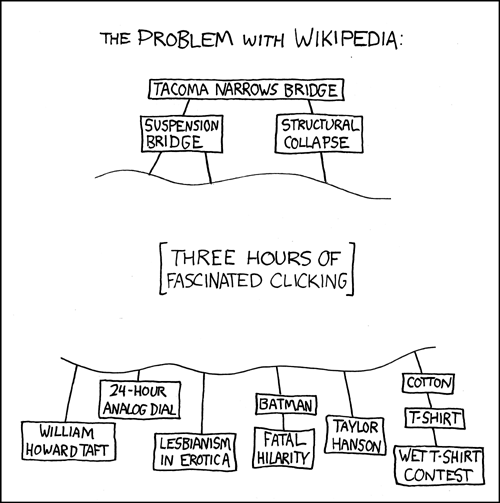
Firstly, there is the issue of timing. I am blessed to be able to live with my grandmother in that I can have good meals every night and not sustain myself solely on ramen. However, often the case is that I get home near 7 and she has dinner to be ready for 7:30. Obviously I'm not a little exhausted after my near twelve hours on campus so I think, “Great. I have a timed half-hour break and then after dinner I take on [insert subject here]” This is a problem. Chances are that I'll be in the middle of something interesting when dinner is ready. Therefore I leave it, midway through, fresh in my mind, to go to dinner. After dinner once everything has been cleared away (as much as possible until my grandmother actually shoos me out of the kitchen) I go back down to get to work, but “I'll just finish what I was doing”. This sucks me right back in to whatever it was, something that is especially deadly on the internet. XKCD did a great comic on this concept. So the conclusion here is to not even start something. Or at least, start something that you know will be finished and done with before the half hour is up. That way you can avoid getting sucked back in.


Secondly, the issue of everything, and I mean everything, being done on the internet for school. In my five courses three have weekly or bi-weekly assignments that are given and submitted all online. As these all involve mathematical equations it is in one's best interest to work on them while online looking at the problem sets and submitting answers one at a time and right away. You then get instant feedback on whether it's right or wrong. It's fantastic. But unfortunately it really messes with my original plan to avoid the internet as much as possible during school hours. I'm required to be there, and thus I'll have moments like “Oh I'll just go check this sports site...and then I'll just glance at the news...or...” and so on. It begins the same process as the first point. I've started printing out the assignments to avoid this. But like I said, the submission and correcting process is online. It's not a great situation. My current strategy is to use IE9 to do the work; the inferior nature of that browser helps keep me from doing other things on the web.


Thirdly, there is the issue of friends. Yes, friends are an issue. Anyone who knows me and has skype knows that I like to leave my status as “away” almost all the time. This would let me use skype as more than just instant messaging; it could be messaging without the instant part so long as I was always in an online sort of status. The trouble, however, lies in that because I'm always some form of online it's much much easier to talk to friends and that can really eat up a lot of time. I'm mostly alone in the house; I have my room downstairs and my grandmother and cousin are upstairs, and other than them I have no real human interaction at all. All my “socializing” (which, for me, means sarcastically insulting the other person) takes place online, and more often than not through skype. It's pretty self-explanatory, really.


Finally, games. They are fun, nothing inherently wrong with them, and often can be quite a good mental exercise. Take Civilization V for example. It is a turn-based empire-building strategy game, which, as the final part of the classification would imply, requires you to think about what steps you are taking and apply the appropriate stratagems at the appropriate time. The trouble is, it's often hard to stop. “Turn-based” means all the action takes place in turns, much like a board game. This would appear to lend itself to an easy game to play for a period of time and then stop. Not so. Far too often I'll tell myself, “I'll play for twenty turns and then stop.” and, twenty turns later, find myself in the middle of an economic crisis, just starting a war, or some other intensely interesting and absorbing situation. Again, much like the first point, if one sets a moment of time in the future as a designated stopping point it's hard to say you'll be at a good stopping point at that time.


So, in conclusion, here is my planned course of action:


  • First, when browsing the internet, stay away from YouTube unless you know exactly what you are going to go find and know to close the window/tab immediately afterwards.

  • Similarly, when browsing the internet at all have at least an outline of your plan. Once you finish this immediately close the browser

  • Leave skype offline for most of the time. Use email for non-instant messaging as it has less potential to distract. Having a chat program open on your computer while doing work makes it so easy for people to start talking to you oblivious of the fact that you are, in fact, working.

  • With online conversations know when to end them.

  • Work away from the computer as much as possible. When working on stuff on the computer try working with someone else at the same time, even if they are not working on the same thing as you. Generally it helps focus (situational, of course)


Well, that's all for now. I had a lot more things I wasn't able to touch on here, as you can probably tell from some of the conclusions that don't specifically follow from stated premises.


I need a longer train ride.

Thursday, 3 November 2011

Welcome!

Info/FAQ

What is this?

This is a blog I've created partially for my own amusement and partially to get thoughts out there. Every morning I have a pretty long commute to school, and the fact that I board a vehicle operated by the Service de Transport de Montreal (Montreal Transport Service) by 6:45 means my brain is not quite awake enough to be doing, say, differential calculus or any such thing. However, it's awake enough to annoy me to no end with random thoughts.

Why are you tormenting the world such?

As I mentioned before, the long bus/train/metro ride lends itself to just letting the mind wander. Whenever mine does that I often have a hard time reeling it back in but that's not the point. Anyone who has been on an overnight flight, or at least a flight where everyone else goes to sleep, will know that long periods of just sitting without a whole lot to do means things start running through your head and eventually you grab one and start mulling it over. I find this process for me results either in some major epiphanies or, far more often, leads, after a while, to completely pointless and useless circles or destructive over-criticism of oneself. Thus, while performing a similar process while trying to get my brain to kindly shut up to let me get some much needed sleep I had one of the epiphany moments; that is, to just use my time on the train to write about various topics. In addition, I've been challenged by multiple groups and people during this single past week to spend more regular times with God. Yes, this blog has theological implications; a lot of them. While granted, this is not a strictly theological setting it will be discussed quite a lot in my effort to meet and far exceed this challenge.

So...again what exactly is this?

Well now that I've provided the background to my decision to create this I can better answer the original question. This is my blank canvas. My portal throw which to throw my ideas. About anything. Ever. I find myself ranting about topics to people who, quite frankly, couldn't care less. That's all the proof I really need for an excuse to make this. That is, I'm bothering people by taking up their time releasing pent-up rants at them, so why not put it here where I get the relief given by delivering the rant and yet if people don't want to see it they don't need to? That's this right here.

What are you going to write about?

Nothing specific. Really just whatever caused me to lose yet another hour of sleep the night before, or something that I've been thinking about recently, or maybe even a news story; frankly, if you're here for discussion of any one topic then you're in the wrong place. There will be no order or organization to any of the topics, well, other than chronological order.

How exactly is this working anyways?

All that really happens is that I pull out my laptop at some point on the trip from home to school in the morning, most likely to happen while waiting for the train. I'll just write about whatever particular topic I have for that day until the end of my journey on the train and once at school (ergo, internet) a quick ctrl-c ctrl-v puts it here and I'm done. This also answers the next question, which is...

What the helium are you thinking in starting a new blog when your photoblog has not been touched for nearly three months???

The simple fact that the primary purpose of this blog is for it to be a more constructive way to spend the wee hours when I'm travelling to school. Unlike the photoblog, which requires a lot of time in that the photos must be selected, uploaded, put into the post, described, small blurb, and so on, this is not going to get any editing or special effects at all, although I might try to throw in the subject-related image here and there to break up the wall of text. That said, yes, I'm trying to set aside time to put work into the photoblog. Hush. That doesn't need to be discussed here.

How often are you going to make a post?

More often than my photoblog. That's all I can really say. Ideally I'd be making a post every time I go to school, which is every weekday. But what with varying daily schedules there may be times where I don't. But again, all I'm doing is basically freewriting and then putting the result on the internet.

So what are your goals in making this?

Primarily I just want to free up a little brain space. Secondly, I do hope to make things interesting enough to generate some discussion of ideas or theories or whatever I've rambled about. Third, if I miraculously manage to actually help anyone in this, that would be great.

So there we go. Welcome to Trains of Thought.

This will be permanently on display in the "About/FAQ" tab.


And does anyone else find it strange that I just wrote a FAQ for the intro....?